
Peacebuilding
PEACEBUILDING
Our Values
Peacebuilding is the cornerstone of Rotary' International's humanitarian mission, and our work is underpinned by the Universal Declaration of Human Rights that Rotary helped develop in 1948 and continues to support today.
Definition: Peacebuilding is an active, long-term process of addressing the root causes of conflict and creating the conditions where people can resolve differences without violence.
Pathways: Rotary invests in peace education and capacity building, fosters strategic relationships, and integrates peacebuilding into all of Rotary's programs and services.
Local to Global: When people work to create peace in their communities, we believe that change can have a global effect.
Root Causes: By carrying out service projects and supporting peace fellowships and scholarships, Rotarians take action to address the underlying causes of conflict including poverty, discrimination, ethnic tension, lack of access to education, and unequal distribution of resources.
Positive Peace Hubs: Rotary is establishing Positive Peace Hubs in communities (established through The Rotary Foundation's Programs of Scale award) to strengthen their capacity to resolve conflicts while addressing persistent inequallities such as social exclusion, food insecurity, and poverty caused by prolonged violence and armed conflict.
Political Practice vs. Value-Based Peace Work: Rotary International is a non-political and non-religious global service organization. However, since most crises and inequities can usually be traced back to politics, a clearer framing is to differentiate Political Practice from Values-Based Peace Work:
- Political Practice supports a party, candidate, government action, policy position, international resolution, or specific political solution. ROTARY DOES NOT OPERATE IN THIS WAY.
- Values-Based Peace Work: Upholds shared principles such as service, dignity, truth, goodwill, fairness, reconciliation, and human rights. ROTARY DOES OPERATE IN THIS WAY.
This Practical Test shows the difference:
If the focus is “which side should win,” it is political; if the focus is “how do we reduce harm and protect dignity,” it is values-based.
In short, our peace work avoids partisan framing, electoral endorsements, political resolutions, or appeals to governments or clubs on political disputes.
Instead, our Rotary-aligned peace work is based on education, credible information, respectful dialogue, humanitarian service, and Rotary's Four Way Test.
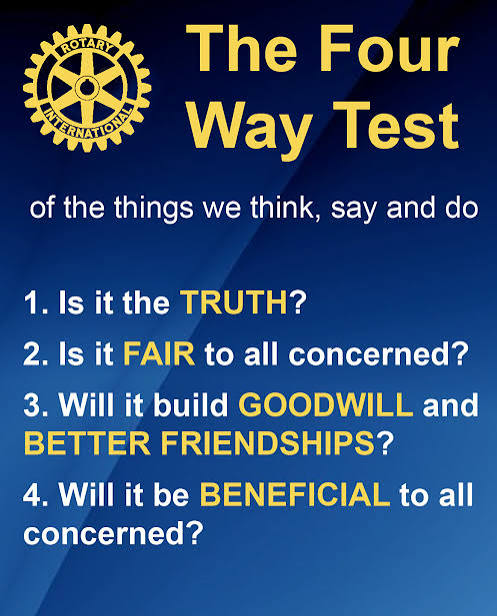
Focus Areas for our Club's Peacebuilding
- Raising awareness and building community - by arranging film screenings, discussions, guest speakers, and breaking bread sessions.
- Strengthening collaborations - with other Rotarians, with students, and with other Guelph organizations working on similar goals.
- Deeper Learning for our own members - sharing opportunities to expand our own learning and understanding in peace work.
- Projects - here is a snapshot of projects under consideration, as of September 2026:
- Mini-lessons in peace for local school children (under consideration)
- Remembrance Day programming (already organized for November 6, 2026)
- A new Rotary Peace Pole in Guelph to celebrate Guelph 200 in 2027 (under consideration)
- A club donation to the District 7080 Peace Committee towards a scholarship in “Peace & Conflict” education at Conrad Grebel Business School, University of Waterloo (under consideration)